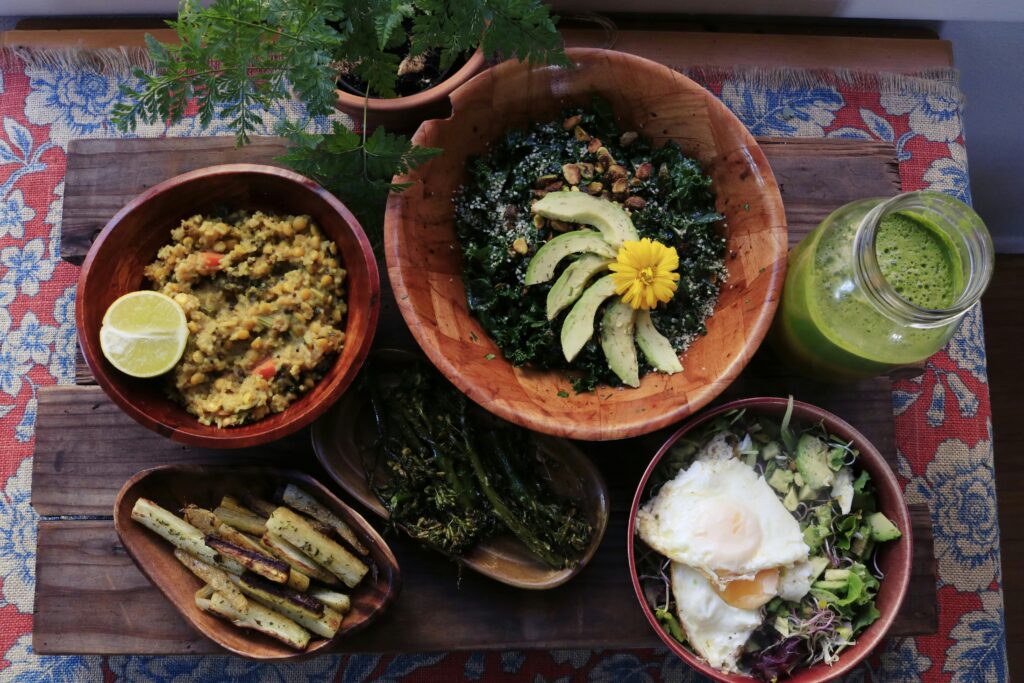
Photo by Chelsea shapouri on Unsplash
Most people have heard about yoga, but fewer know about ayurveda. If yoga is the physical and spiritual practice, ayurveda is the science of health, based upon practices refined over thousands of years in South Asia.
I’ve been experiencing a burnout, and I’ve found that our modern-day approaches are pretty poor. Ayurveda gave me the first systemic explanation of burnout that actually made sense. My body’s ojas, or vitality being depleted, the body would need rest. It takes as long as it needs, and although there are things that help, there is no shortcut to rest. This was honestly pretty revolutionary for how I approached my burnout.
My exploration got me into learning more about the fundamentals of ayurveda. There are three different prakritis, or constitutions. These are Vata – made up of ether and air; Pitta, made up of fire and water, and Kapha, made up of water and earth. We are made up of different combinations of these three things.
As someone who has struggled with their weight throughout my life, I finally had a framework to help explain why. I have a dominant Kapha prakriti, meaning a strong build, but one prone to lethargy. My challenge is that I am constitutionally built to hold weight, making being thin difficult. The upside is that I have generally healthy skin and hair.
Ayurveda is clear that there’s no point in someone like me trying to be skinny, like a Vata dominant type would be. They naturally lose weight easily, but are also more likely to have dry hair and other issues. Pitta dominants meanwhile are medium build, likely to be competitive and sporty, but are more prone to have issues around inflammation and anger.
In the midst of this burnout, I learnt about my own neurodivergence. I received an Autism assessment in 2024, and although untested, I am sure I have ADHD too. This means I fit into the particular category often called ‘AuDHD’. The strange blend of craving creativity but also routine.
A few months ago, I went to see an ayurvedic doctor for a pulse check. What was interesting was that I had both an excess in Kapha and Vata. The Vata made sense – the element of air represents shifts and changes, which describes my constantly shifting burnt out brain perfectly well. But the Kapha was more surprising – I had presumed that since I was low in energy, that meant that my Kapha reserves had been exhausted.
I started reading a new book, entitled Yoga and Ayurveda by Dr. David Frawley. I’ve only reached a few chapters in, but I read something that shifted my thinking dramatically. In Ayurveda, we all have prakritis. But there are ancient texts that state we can have different prakritis for our body and our mind.
This clicked a new understanding. Perhaps my body’s tendency is to be Kapha dominant, whereas my mind is Vata dominant. These two in excess lead to imbalance, but in very different ways.
This made my mind return to how this might map onto neurodivergence. As my brain ticked along, I realise that it actually maps up extremely well. If we follow the logic of ayurveda, we can get many different valuable answers too.
Let’s start with someone with an ADHD profile. They are often people who are fidgety and constantly shifting thoughts. These two things map clearly. They have a vata dominant mind, and a vata dominant body.
Likewise, someone with Autism. They are Kapha dominant in mind and body. Physically, they tend to like routine and discipline. Mentally, they can be very structured, to the point of inflexibility.
Then, there are AUDHD people like me. I have a very fast moving, Vata dominant mind, but a Kapha dominant body that likes to sit still. This is a strange combination, and one that is perenially misunderstood, and often mistreated too.
But there’s nothing to say it couldn’t be the other way around, I could be a Kapha dominant mind – someone who needs clear conceptual structure – but a Vata body that needs high physical stimulation.
What is really interesting is that we can break this down further. As mentioned earlier on, constitutions are made up of different elements.
Let’s take the example of Autism. The stereotype of autism is often based upon having alexithymia – having a lower level of empathy and ability to experience emotions. This suggests someone who has a very earth dominant Kapha. The earth builds resistance which leads to difficulties when connecting with others.
But we are also seeing a growing number of autistic people who do not fit this mould. Women, ethnic minorities and queer people often have a very different experience. These are people who have heightened sensitivity (oft fitting into the ‘Highly Sensitive Person’ category), yet still exhibit wider autism traits. I would definitely count myself in this group. For these people, they have an excess of water – the element which governs flow and emotions. This causes their Kapha imbalance.
Likewise with ADHD, my hypothesis is that there are different archetypes. There are those who are much more ‘air’ heavy. These are people who are in constant motion, they are often continuously reacting to things in front of them and live their life in a free-flowing state of response. This can be categorised as those with strong impulse responses.
But then there are also those ADHD profiles that are ether dominant. Ether governs space, and can be described as covering creative potential. These are the people who constantly have new ideas, but may struggle to finish them. It fits the archetype of a person with ADHD who has started twenty different projects but struggles to complete any of them.
This dissection alone I think is a very valuable way of framing neurodivergence, beyond what traditional literature says. I can only report from anecdotal experience, but this matches up pretty well with what I see from the neurodivergent community.
But there is more value to this than just a diagnostic tool. Ayurveda is rich because it has a direct ability to treat different imbalances. I am not an expert on exact remedies, but the fact that treatments exist could be an extremely valuable resource. I know that my own methods of applying mustard oil on my skin during the night has done wonders in reactivating my body from its Kapha-excess slumber. Perhaps this may be good for other autistic folk too.
But Ayurveda can also help us understand how we may work to fix this balance from an energetic perspective. The one prakriti that I have not talked much about is Pitta. Pitta governs our internal flame, and plays a key role in digestion. When it is out of balance, stomach problems often follow. It’s perhaps not a coincidence that neurodivergent people have higher rates of IBS.
Pitta is extremely important because it is the central prakriti that can bring our dominant sides into balance. The fire can give drive and direction for Vata-heavy ADHD people, and it can also push Kapha-heavy autistic people out of their shell.
I believe this is why we are often so sensitive to meaning. Burnout is often caused when we no longer feel like our work matters. Our internal flame is generally more fragile due to our constitution, so it can get put out easier. I always found it so difficult in my job for this reason, which I noticed was in contrast to the rest of my colleagues. It seems like neurotypical people are less sensitive to this.
We therefore need to be far more careful with how we guard our Pitta, or internal fire. Doing things that are Pitta draining are more negatively impactful for neurodivergent people. I think it is why we are so sensitive to meaning, and often are characterised as ‘justice seeking’. We need to ensure that what we are doing keeps that internal flame going.
Things that have a minor effect on others’ Pitta can have a disproportionately high affect on ours. Neurotypical people without such dominant Vata or Kapha are less prone to this. Or, they may be naturally Pitta-dominant people, who are naturally competitive anyway.
It is therefore more important to be extra guarded with our time and energy. I feel some level of confidence in saying this, because it lines up with pretty much all the advice that circulates in neurodivergent groups.
I realise that I am but a voice in an ocean of opinions around neurodivergence. But I do think also that there is something that can be extremely valuable for people by looking through this lens.
I am sure that there is much more that can be dug into beneath this through the thousands of years of ayurvedic practice that could massively help neurodivergent people. We are, after all, a chronically under-served community.